
For most of our lives, movement feels automatic.
- We step off a curb without thinking.
- We reach to catch something that slips from our hands.
- We turn quickly when someone calls our name.
These movements seem simple, yet they depend on an intricate combination of systems working together — the brain, the nervous system, the muscles, and the inner ear.
With age, these systems gradually change.
- Muscles become weaker if they are not challenged.
- Reaction times slow slightly.
- Joint stiffness can alter movement patterns.
One of the most significant consequences is a decline in balance and power — two physical qualities that rarely receive the same attention as strength or aerobic fitness.
Yet from a longevity perspective, they may be among the most important.
Balance and power help determine whether a person can prevent a fall, react quickly to an unexpected movement, and remain physically confident in everyday life.
They influence independence, mobility, and quality of life.
And the encouraging news is that these capacities can be improved at almost any age when they are trained appropriately.
Why Balance Changes As We Age
Balance is often misunderstood.
Many people assume balance is simply a matter of standing on one leg or strengthening the ankles.
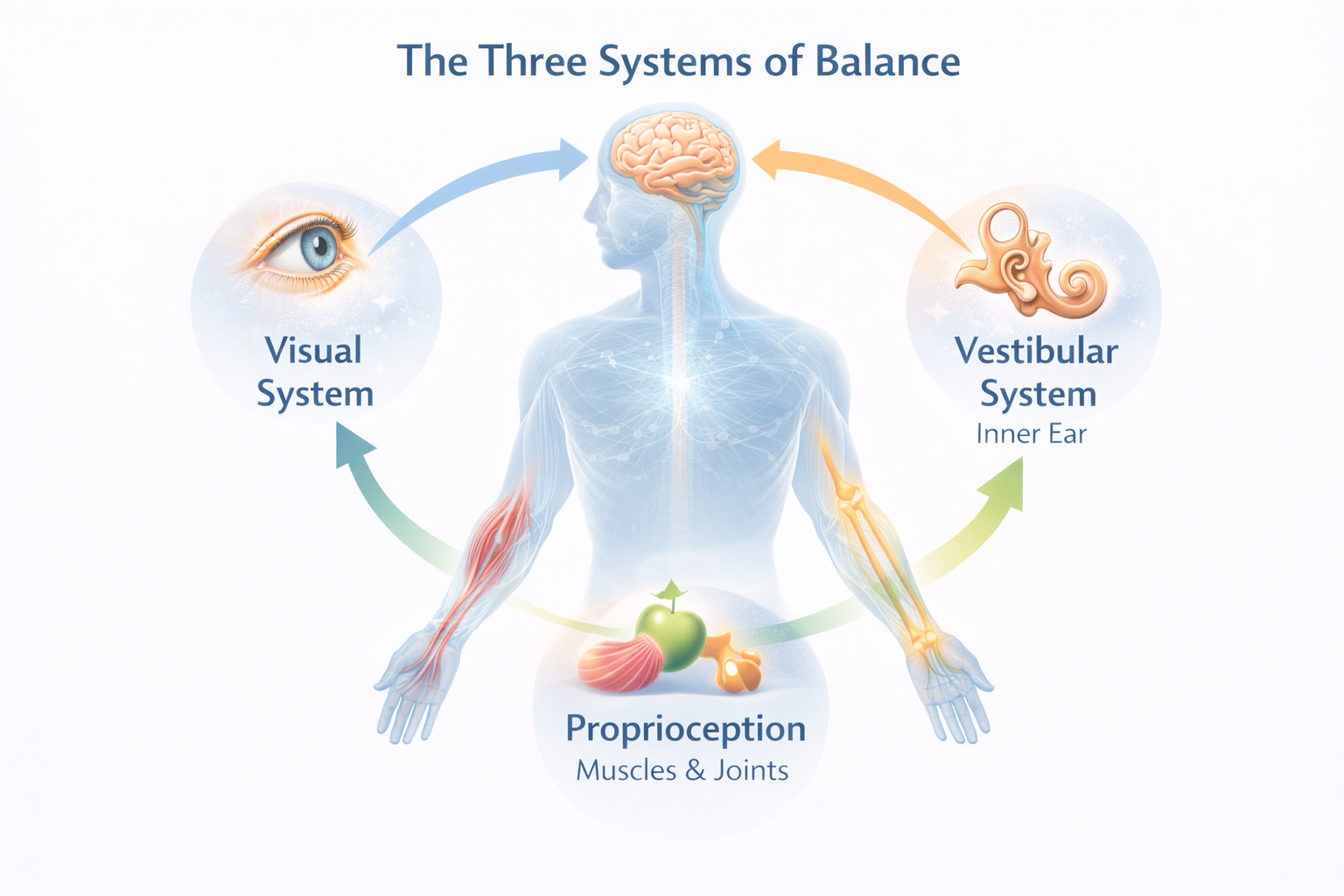
In reality, balance is the result of three separate systems working together.
The first is the visual system. The eyes provide constant information about the environment — where the body is in space and how it relates to surrounding objects.
The second is the vestibular system, located in the inner ear. This system detects head movement and orientation relative to gravity. It acts as the body’s internal level, helping maintain stability when the head moves.
The third is the proprioceptive system, sometimes described as the body’s sense of position. Receptors in muscles, joints, and tendons constantly send information to the brain about limb position and movement.
The brain integrates signals from all three systems and adjusts muscle activity in real time to maintain stability.
With age, subtle changes occur in each of these systems.
- Visual acuity may decline slightly.
- Vestibular sensitivity becomes less precise.
- Proprioceptive feedback from joints and muscles becomes less responsive.
These changes are usually gradual, which is why many people do not notice them immediately.
However, when the systems that regulate balance become less efficient, the body has a smaller margin for error when reacting to sudden changes in movement.
This is one reason why falls become more common later in life.
The important point is that balance is not fixed. Like strength and cardiovascular fitness, it can be trained and improved.
The Science of Power: Why Speed Matters As We Age
While balance helps maintain stability, power allows the body to react quickly.
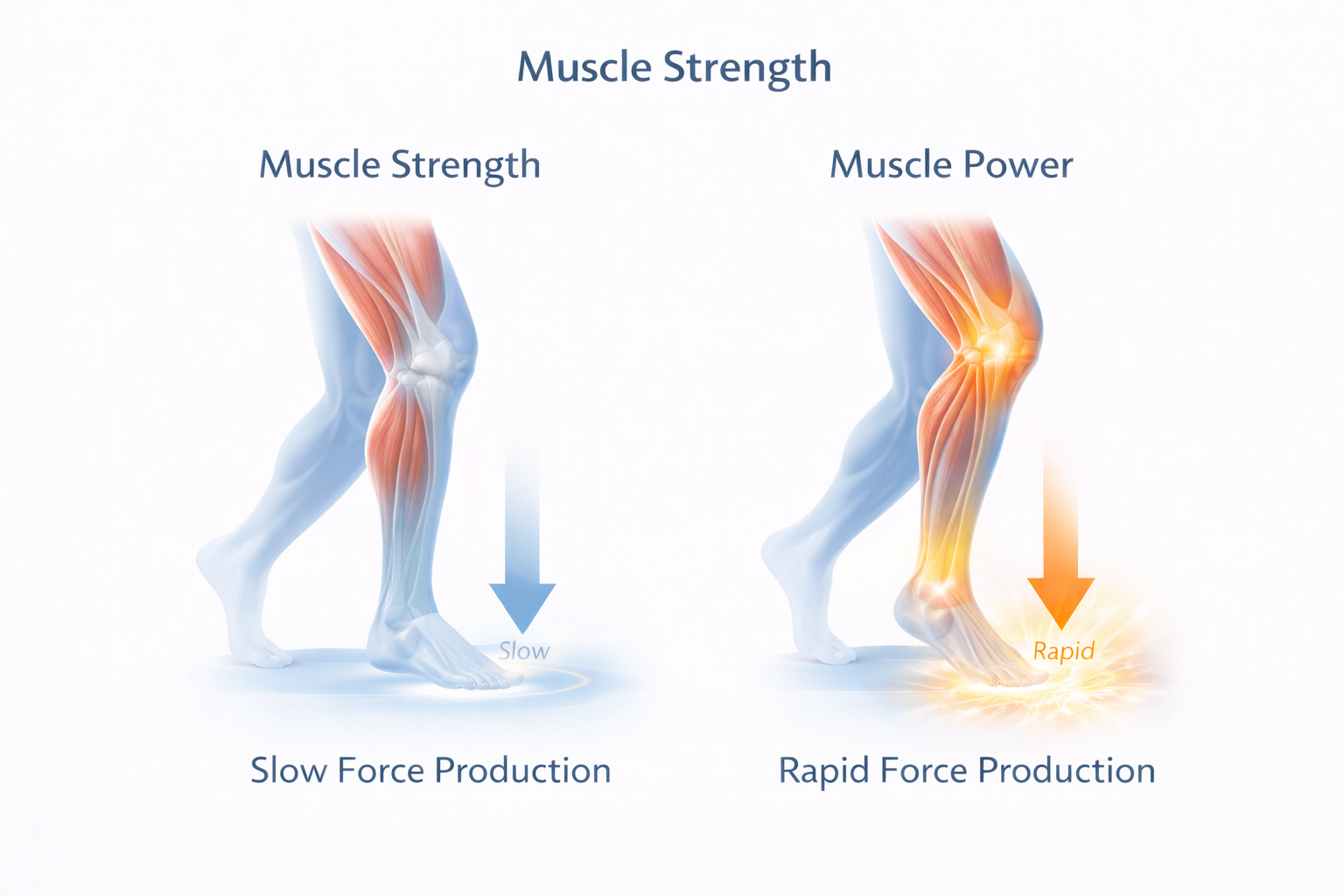
Power is defined in physiology as the ability to produce force rapidly.
In practical terms, it is the difference between slowly standing from a chair and rising quickly when needed. It is the ability to catch yourself when you trip, step quickly to regain balance, or climb stairs with confidence.
Research in aging physiology has shown that muscle power declines earlier and faster than muscle strength.
Strength refers to how much force a muscle can produce.
Power refers to how quickly that force can be generated.
Beginning around the fifth decade of life, fast-twitch muscle fibres — the fibres responsible for rapid movement — gradually decline if they are not regularly used.
At the same time, the nervous system becomes slightly slower at activating muscle fibres.
Together, these changes reduce the body’s ability to generate rapid movement.
This is important because many everyday movements require speed rather than maximum strength.
Preventing a fall, for example, depends on how quickly the body can react.
Several studies have shown that lower limb power is one of the strongest predictors of functional independence in older adults.
Individuals with better leg power tend to walk faster, climb stairs more easily, and maintain higher levels of physical independence.
For this reason, modern longevity training programmes increasingly include gentle power-based movements rather than focusing solely on slow strength exercises.
The Nervous System: The Hidden Driver of Movement
Balance and power both depend heavily on the nervous system.
When we move, the brain sends signals through motor neurons to activate muscles in precise sequences. This process happens extremely quickly, often within fractions of a second.
These neural signals determine:
• how many muscle fibres are recruited
• how quickly they are activated
• how well different muscles coordinate together
With age, the nervous system becomes slightly less efficient at transmitting these signals.
This does not mean movement must inevitably decline.
In fact, research shows that regular movement training can maintain and even improve neuromuscular function later in life.
Activities that challenge coordination, reaction time, and movement variability stimulate the brain as much as the muscles.
This is one reason why exercises involving balance, stepping patterns, changes of direction, and controlled instability are valuable for older adults.
They encourage the nervous system to remain engaged and responsive.
From a brain health perspective, these types of movements may also stimulate neural pathways associated with coordination and spatial awareness.
In other words, training balance and power does not only strengthen the body.
It also helps keep the brain’s movement control systems active and adaptable.
The Relationship Between Balance, Strength and Aerobic Fitness
Balance and power do not exist in isolation.
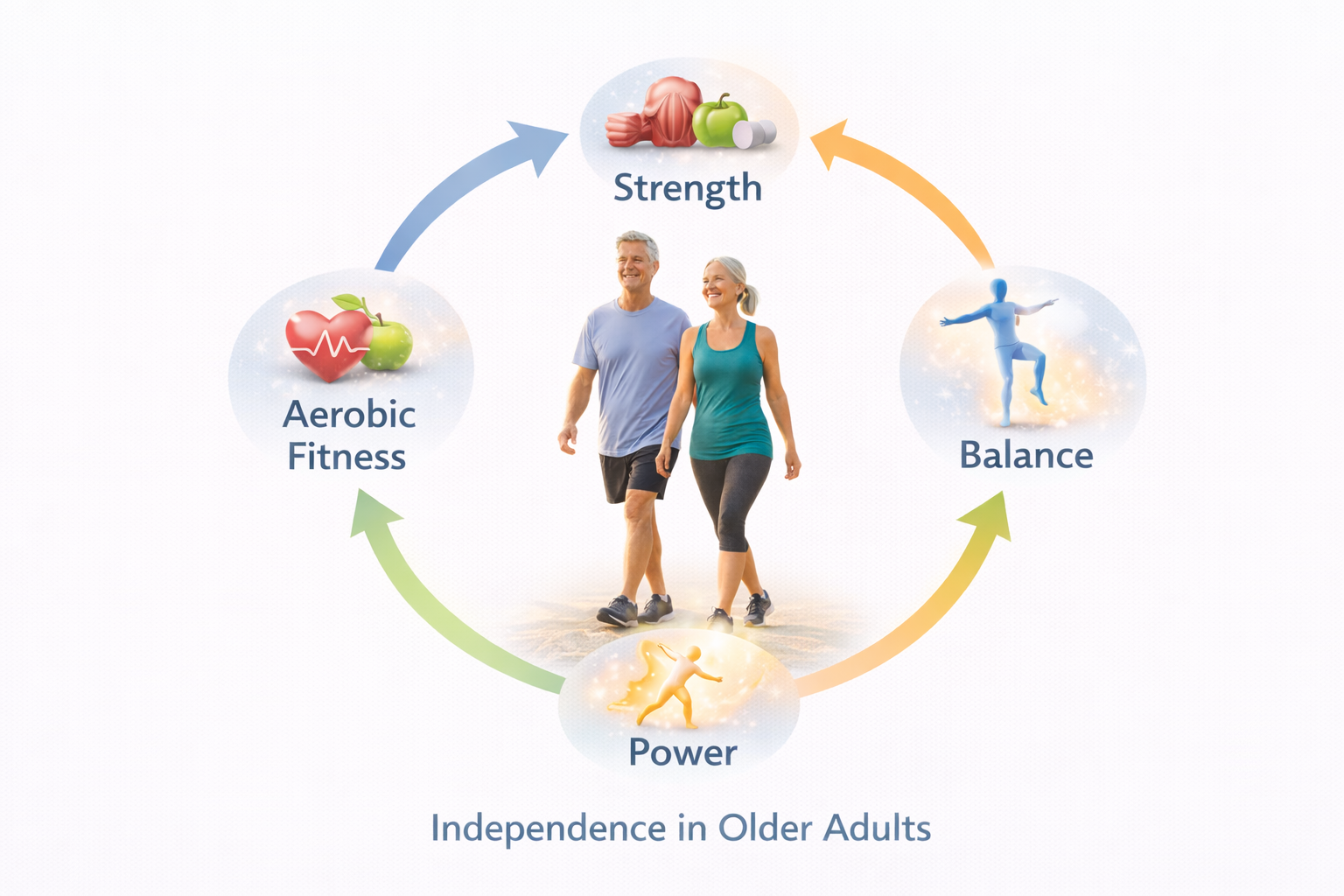
They depend on a foundation of strength and cardiovascular health, and when these systems work together the body moves more efficiently, more confidently, and with far less effort.
Strong muscles provide the force required for movement.
Aerobic fitness ensures the body has the energy to sustain activity without excessive fatigue.
Balance and power allow that strength and energy to be used quickly, safely and effectively.
When these qualities are developed together, movement becomes smoother and more responsive.
In practical terms, this has a direct impact on everyday life.
Climbing stairs requires more than just leg strength. Each step involves coordination between the nervous system, muscles and joints. Power allows the body to lift itself efficiently, balance stabilises the movement, and cardiovascular fitness ensures the effort can be repeated without becoming breathless.
These abilities also become important during unexpected situations.
If a person trips slightly while walking, the ability to react quickly with a corrective step often determines whether they regain their balance or fall. This reaction relies on lower-body power and neuromuscular coordination, not just raw strength.
The same principle applies when carrying shopping, lifting a suitcase while travelling, or getting up quickly from a chair. These movements require the body to produce force rapidly while maintaining stability.
Well-designed training programmes recognise this interaction between systems.
Rather than focusing on a single type of exercise, they typically combine several elements:
• Aerobic activity, such as walking or cycling, to support cardiovascular health and endurance
• Resistance training, to maintain muscle mass, joint stability and bone density
• Balance and coordination exercises, which challenge the nervous system and improve reaction time
For instance, regular walking improves circulation, heart health and mitochondrial function, helping the body sustain activity throughout the day.
Strength training supports the musculoskeletal system, maintaining the muscle and bone tissue required for independence.
Balance and agility drills train the nervous system to react quickly and stabilise the body during movement.
When these components are integrated, they reinforce one another.
A stronger body stabilises itself more effectively.
A healthier cardiovascular system improves recovery and resilience.
A responsive nervous system allows movements to remain fluid and coordinated.
Over time, these improvements translate into a higher level of physical confidence.
People feel more comfortable walking outdoors, navigating unfamiliar environments, travelling, or participating in activities with family and friends.
This integrated approach reflects how the human body naturally functions.
It is also one of the reasons why traditional active cultures around the world tend to maintain physical independence well into older age. Their daily routines involve varied movement patterns — walking, carrying, bending, reaching, climbing and balancing — rather than repetitive single-mode exercise.
In this sense, maintaining balance, power, strength and aerobic fitness is not simply about improving physical performance.
It is about preserving the ability to move freely, respond confidently to the environment, and remain fully engaged in everyday life.
Training Balance and Power Safely
Training balance and power does not require extreme exercises or high-impact movements.
In fact, for most people over 60, small progressive challenges are often far more effective than demanding workouts.
The reason lies in how the nervous system learns and adapts.
Balance is not simply a matter of strengthening muscles. It is a process of training the brain and nervous system to coordinate movement efficiently. When the body encounters a slightly unstable position — such as standing on one leg or stepping onto an uneven surface — thousands of tiny adjustments occur in the muscles of the feet, ankles, hips, and core.
Sensors within muscles and joints send information to the brain about body position. The brain then sends signals back through the nervous system to adjust muscle tension and maintain stability. This process happens continuously, often many times per second.
This system is known as proprioception — the body’s internal awareness of where it is in space.
Exercises that gently challenge balance stimulate this system and improve communication between the brain and muscles. Over time, the nervous system becomes better at detecting small changes in stability and responding quickly.
Power training works through a slightly different mechanism.
While strength exercises develop the ability to produce force, power training improves the rate at which that force can be generated. In physiology this is known as the rate of force development, or RFD.
This is important because many real-world movements require force to be produced quickly rather than slowly. Catching yourself when you trip, stepping quickly to avoid an obstacle, or standing up rapidly from a chair all rely on rapid muscle activation.
Power training stimulates the nervous system to recruit muscle fibres more quickly and efficiently. The brain becomes better at activating motor units — groups of muscle fibres controlled by a single nerve — allowing muscles to respond more rapidly when movement is required.
Importantly, this type of training does not require explosive jumping or high-impact activity.
Simple movements can achieve the same neurological effect when performed with controlled intent.
For example, standing up from a chair with purpose, stepping quickly onto a low platform, or performing gentle stepping patterns can encourage rapid muscle activation without excessive joint stress.
Equipment such as suspension trainers, resistance bands, and bodyweight exercises can all be used effectively because they allow movement challenges to be adjusted gradually.
The goal is not to create exhaustion or fatigue.
The goal is to stimulate the coordination between the brain, nervous system, and muscles.
When these systems are challenged regularly, they remain adaptable.
Neuroscientists often refer to this process as neuroplasticity — the ability of the brain and nervous system to reorganise and strengthen pathways in response to repeated movement.
In practical terms, this means the body continues practicing how to stabilise itself, react to unexpected changes, and generate movement efficiently.
Over time these adaptations translate into noticeable improvements in daily life.
People find they can step more confidently on uneven ground, recover more easily if they stumble slightly, rise from chairs or climb stairs with less effort, and maintain a greater sense of control over their movement.
In other words, balance and power training does not simply improve exercise performance.
It improves how the body responds to the unpredictable movements of everyday life.
Below is one example of the type of power exercise I use in Rockfit 60+ classes.
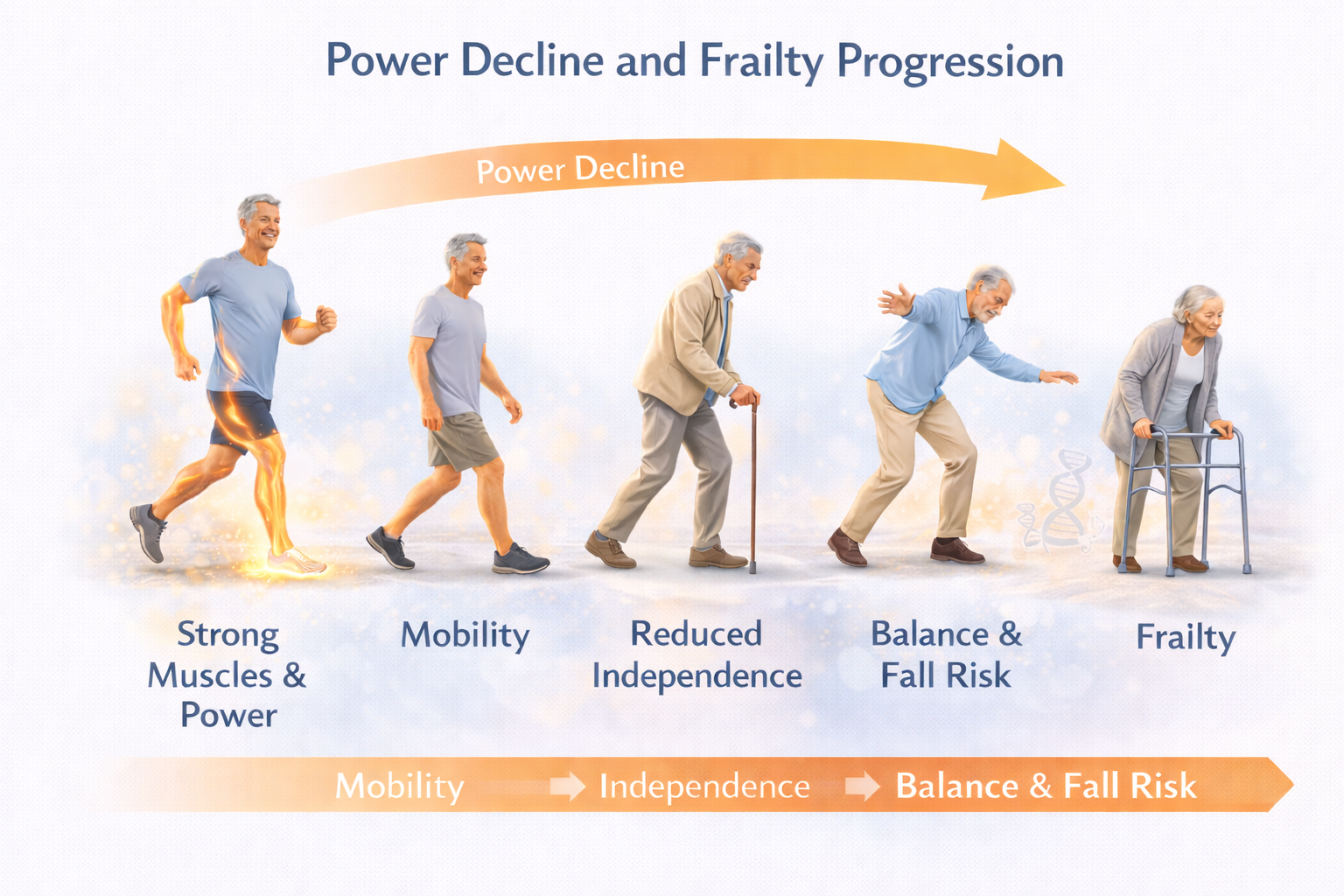
Why Loss of Power Is One of the Earliest Predictors of Frailty
One of the most important discoveries in aging physiology over the past two decades is that loss of muscular power often occurs earlier than loss of strength.
For many years, researchers focused primarily on sarcopenia — the gradual loss of muscle mass that occurs with aging. While muscle loss remains an important factor, scientists now recognise that the ability to generate force quickly may be even more important for maintaining independence.
This is because everyday movement rarely requires maximum strength.
Instead, it often requires the body to react quickly.
If someone trips on an uneven surface, the ability to place a corrective step rapidly may prevent a fall. If a person begins to lose balance while turning, the body must generate force quickly through the legs and hips to stabilise itself.
These rapid responses depend on muscle power, not just muscle size or strength.
Studies examining functional independence in older adults consistently show that measures of lower-body power — particularly the ability to stand from a chair quickly — are strong predictors of mobility and fall risk.
One widely used clinical assessment is the sit-to-stand test, where individuals are asked to stand up from a seated position repeatedly over a short period of time. Performance in this simple movement correlates strongly with walking speed, balance, and overall functional independence.
This is not surprising when we consider how frequently similar movements occur during daily life.
Standing from a chair.
Climbing stairs.
Stepping up onto a curb.
Getting out of a car.
Each of these actions requires the body to produce force quickly while maintaining balance.
When muscular power declines, these movements become slower and more effortful. Over time, individuals may begin avoiding activities that feel physically demanding.
This reduction in movement can create a cascade of changes.
Muscle mass gradually declines.
Aerobic fitness decreases.
Balance becomes less practiced.
The result is a progressive reduction in physical capability — a process that geriatric researchers often refer to as frailty.
Frailty is not simply a matter of aging. It represents a reduction in the body’s ability to respond to physical stress.
People who maintain muscular power and coordination tend to preserve a much larger “reserve capacity” in their movement systems. This reserve allows them to adapt to sudden changes in terrain, recover from small stumbles, and maintain independence in everyday life.
Encouragingly, research shows that power can be improved at almost any age when the nervous system is regularly stimulated through movement.
Even simple exercises that encourage rapid muscle activation — such as stepping patterns, chair rises performed with intent, or controlled agility drills — can help maintain the neuromuscular pathways responsible for fast reactions.
In this sense, power training is not about athletic performance.
It is about preserving the body’s ability to respond to the unexpected demands of everyday life.
The Longevity Perspective
Longevity is often discussed in terms of lifespan.
But for most people, the more important question is far simpler:
Will I still be able to move through life with confidence?
Will climbing stairs feel easy or exhausting?
Will walking on an uneven path feel natural or uncertain?
Will travelling, exploring new places, and playing with grandchildren still feel possible?
These everyday experiences depend on more than muscle size or cardiovascular fitness alone.
They depend on how effectively the body can stabilise itself, react quickly, and generate force when needed.
That is the role of balance and power.
They are the qualities that allow the body to recover from a stumble, step quickly to regain stability, and maintain control during movement.
Without them, the world gradually becomes smaller.
People walk less confidently.
They avoid uneven ground.
They become more cautious with movement.
Over time this reduction in movement often leads to further loss of strength, mobility, and cardiovascular fitness.
But the encouraging news is that the nervous system remains remarkably adaptable well into later life.
When balance and power are trained regularly — even through simple stepping patterns, controlled agility drills, and strength exercises performed with intent — the body continues to maintain the coordination and responsiveness required for everyday movement.
In combination with strength training, aerobic fitness, good nutrition, and restorative sleep, these qualities form a powerful foundation for healthy aging.
The goal is not to train harder than everyone else.
The goal is something far more valuable.
To remain capable.
To keep walking confidently along coastal paths.
To continue travelling and exploring.
To stay active with family and friends.
Balance and power help ensure that the years ahead remain not only longer — but fuller, stronger, and more independent.
Because healthy aging is not simply about adding years to life.
It is about maintaining the strength, balance, and vitality to fully live those years.
That is the philosophy behind the Bluezone approach.